
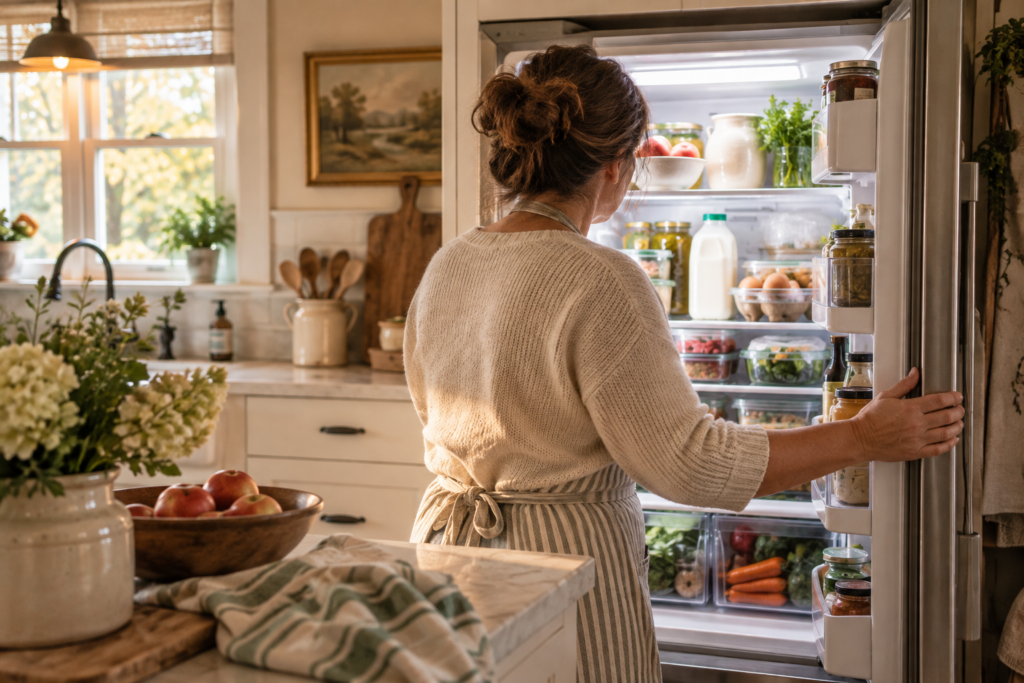
The other day, I pulled a half gallon of buttermilk from the refrigerator and noticed the date stamped on the carton: September 12.
My first thought was probably the same one many of us have had: Do I need to use this right now?
Maybe I should make biscuits. Or pancakes. Or find something—anything—to use up the rest before I had to throw it away.
But then I stopped and thought about what that date actually meant.
Was September 12 the day the buttermilk suddenly became unsafe? Was it simply the date the manufacturer expected it to be at its best? And how was I supposed to know the difference?
For something printed on nearly every carton, package, and jar we bring home, food dates can be surprisingly confusing.
And that confusion can cost us money.
We may throw away perfectly usable food simply because a date has passed. On the other hand, we don’t want to keep a perishable food longer than we safely should simply because it still looks or smells all right.
So I wanted to put together the kind of guide I would actually want in my own kitchen: what those dates mean, how long common foods can be stored, when the freezer can save something before it goes to waste, and when it’s simply time to throw something away.
First, Food Dates Don’t Always Mean What We Think They Mean
Here’s probably the most important thing to understand:
Most dates printed on food packages are about quality—not the exact day a food becomes unsafe.
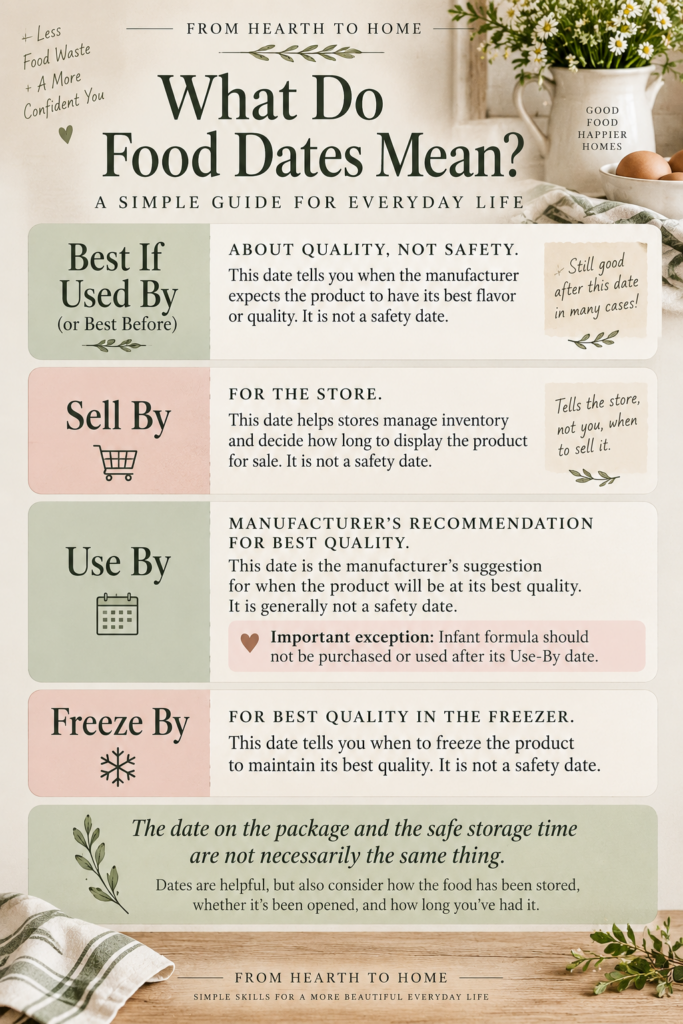
According to USDA guidance, dates such as Best If Used By, Sell By, Use By and Freeze By generally relate to a food’s quality or inventory management rather than serving as food-safety deadlines. Infant formula is an important exception: it should not be used after its Use-By date.
That doesn’t mean dates should simply be ignored.
It means we need to understand what they’re actually telling us.
What Do Best By, Sell By, Use By and Freeze By Mean?
A Best If Used By or Best Before date tells us when the manufacturer expects the food to have its best flavor or quality.
A Sell By date is primarily there to help the store manage inventory and determine how long a product should be displayed for sale.
A Use By date is the manufacturer’s recommendation for when the product will still be at peak quality. Again, this generally isn’t a safety date, with infant formula being the important exception.
And a Freeze By date tells us when the manufacturer recommends freezing a food to help maintain its best quality.
The simplest thing to remember is this:
The date on the package and the safe storage time are not necessarily the same thing.
Then How Do I Know If Food Is Still Safe?
This is where things get a little more complicated.
You’ve probably heard someone say:
“Just smell it. If it smells fine, it’s fine.”
Unfortunately, food safety isn’t quite that simple.
Spoilage can certainly give us warning signs. Food that develops an unusual odor, texture, color, mold or other obvious signs of spoilage should be discarded.
But the opposite isn’t necessarily true.
A food looking and smelling normal doesn’t prove that it’s safe.
Some harmful microorganisms cannot be detected by sight, smell or taste.
So instead of relying on the package date—or our nose—alone, we need to look at the whole picture.
Ask These Five Questions
Before deciding whether to keep or discard a questionable food, ask yourself:
- How long have I actually had it?
- Has it been stored at a safe temperature?
- Has the package been opened?
- What is the recommended storage time for this particular food?
- Are there any signs of spoilage or damaged packaging?
That gives us much better information than looking at a date stamped on the carton and automatically tossing it into the garbage.
Know Your Refrigerator and Freezer Temperatures
One of the simplest food-safety habits we can establish at home is knowing the actual temperature of our refrigerator.
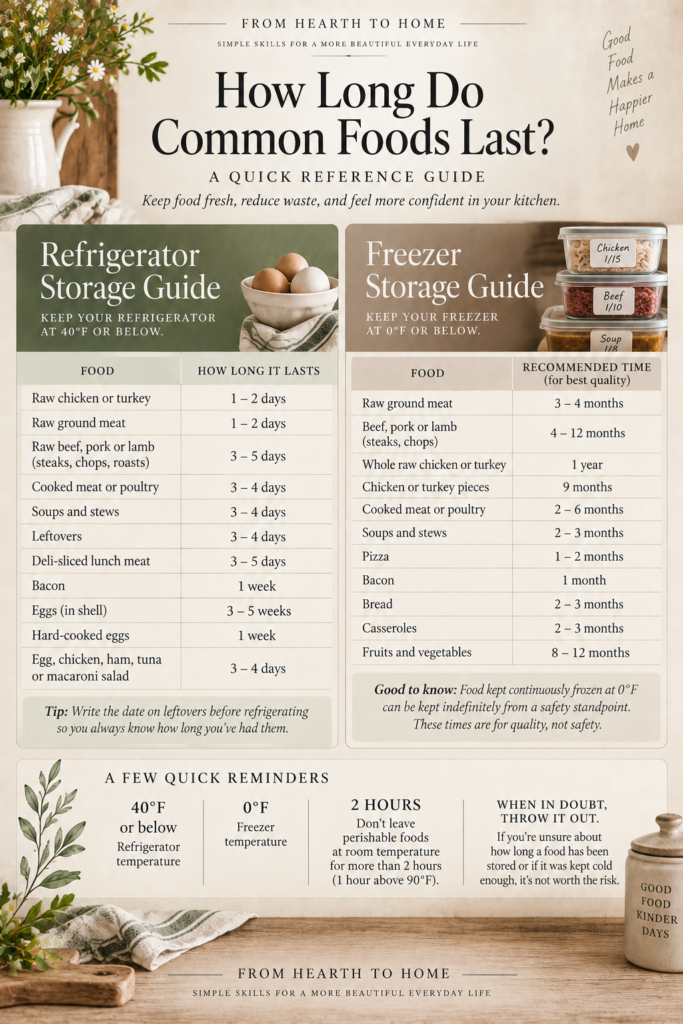
The FDA recommends keeping your refrigerator at 40°F or below and your freezer at 0°F.
If your refrigerator doesn’t have a built-in thermometer—or you don’t trust the one it has—an inexpensive appliance thermometer can take a lot of the guesswork out of it.
Perishable food also shouldn’t sit at room temperature indefinitely. Foods that require refrigeration generally should not be left at room temperature for more than two hours. When the temperature is above 90°F, that drops to one hour.
That includes the forgotten groceries sitting in the car, the leftover casserole on the counter and the food that’s been hanging around after a summer picnic.
How Long Do Common Foods Last?
This is where a good kitchen reference becomes much more useful than trying to memorize every food-storage rule.
For example, raw poultry and ground meat generally have relatively short refrigerator lives—about one to two days—while fresh steaks, chops and roasts generally have about three to five days.
Many cooked leftovers, soups and stews fall into the three-to-four-day range.
Shell eggs can generally be refrigerated for three to five weeks.
You certainly don’t have to memorize all of this.
In fact, I wouldn’t.
Remember a few of the big ones and keep a reliable reference handy for the rest.
Homemaker’s Tip: Put a small piece of masking tape on leftover containers and write the date on it before putting them into the refrigerator.
It takes about five seconds and eliminates the Wednesday-night game of “Did I make this Sunday or last Thursday?”
Don’t Forget About Your Freezer
Sometimes the question isn’t:
Can we still eat this today?
The better question is:
Are we realistically going to eat this before it needs to be used?
If the answer is no, the freezer can often save it.
You bought a package of pork chops but your dinner plans changed?
Freeze them.
You made too much soup?
Freeze some.
You have cooked chicken in the refrigerator that you know nobody is going to get to?
Don’t keep moving it around the refrigerator hoping someone eventually eats it. Freeze it while it’s still within its safe storage window.
And here’s something many of us don’t realize: recommended freezer storage times are generally about quality.
Food kept continuously frozen at 0°F or below can be kept indefinitely from a food-safety standpoint, although its quality will eventually decline.
So the package of ground beef that has been frozen longer than the recommended quality window doesn’t suddenly become unsafe at midnight on a particular date. Its flavor and texture may simply not be as good.
And please label what you freeze.
Otherwise, the dinner you carefully saved eventually becomes a mysterious frozen brick that nobody wants to claim.
Want More Practical Homemaking Help?
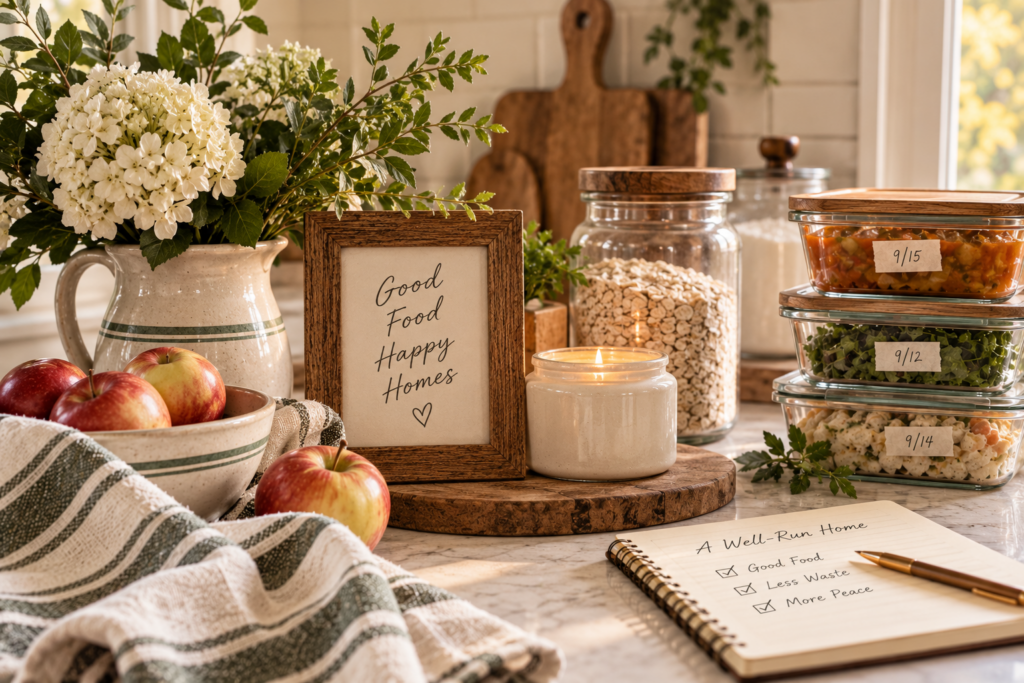
Simple homemaking doesn’t have to be complicated.
Join me for the From Hearth to Home Journal, where I share practical homemaking skills, tried-and-true recipes, simple ways to stretch the household budget, and encouragement for creating a well-run home in real life.
JOIN THE FROM HEARTH TO HOME JOURNAL
Simple, practical homemaking for real life.
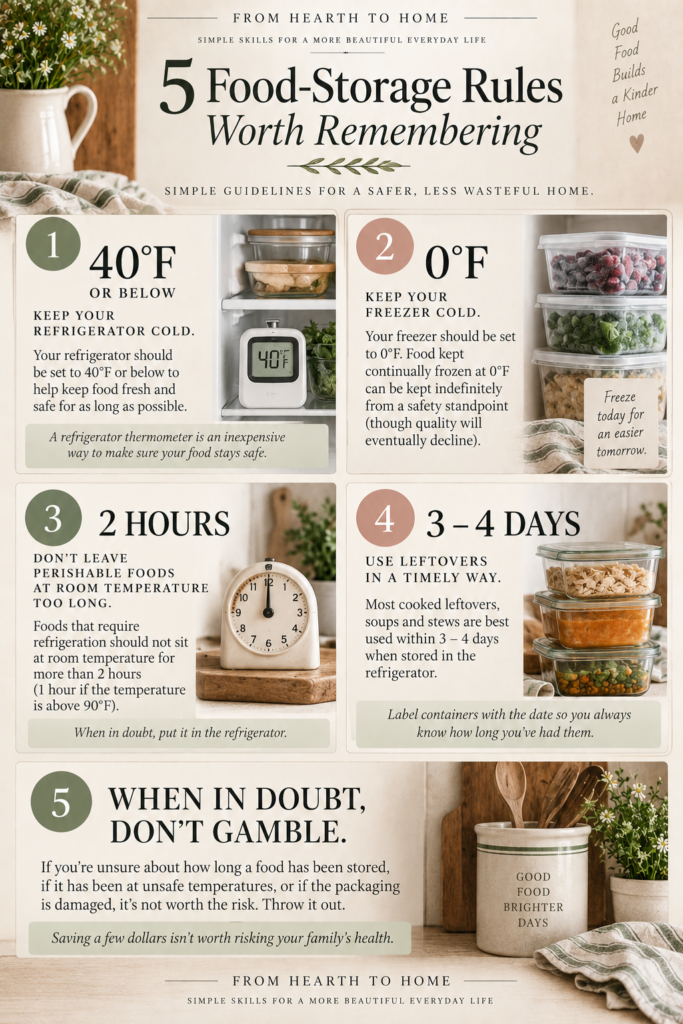
Five Food-Storage Rules Worth Remembering
If all of these numbers are beginning to feel like a lot, don’t worry.
You don’t need to memorize a government food-storage manual to run your kitchen well.
There are a handful of basic rules that will cover a surprising number of everyday situations:
40°F or below: Keep your refrigerator cold.
0°F: Keep your freezer at 0°F.
Two hours: Don’t leave perishable foods at room temperature longer than two hours—or one hour when the temperature is above 90°F.
Three to four days: This is a useful number to remember for many cooked leftovers, soups and stews.
And finally:
When in doubt, don’t gamble.
If you genuinely don’t know how long a highly perishable food has been sitting around or whether it has been kept safely cold, saving a few dollars isn’t worth the risk.
What About Pantry Food?
Shelf-stable food is another place where date confusion can cause unnecessary waste.
A box of pasta doesn’t suddenly become dangerous at midnight because yesterday was its Best By date.
Again, many package dates are intended to help consumers know when a product should be at its best quality.
So I wouldn’t clean out my pantry by automatically throwing away every package whose Best By date has passed.
Instead, use the date along with the type of food, how it has been stored and the condition of the packaging.
Keep pantry foods in a cool, dry place, and rotate your stock so that you’re using the oldest food first.
That’s the old first in, first out system:
Put the newer food behind the older food.
It isn’t fancy, but it works.
Pay Attention to Canned Food
The condition of a can matters.
Don’t try to save a questionable can simply because the food inside cost a few dollars.
Cans that are swollen, leaking, punctured, have extensive deep rust or are seriously damaged should be discarded.
Saving money is good homemaking.
Taking unnecessary chances with food safety isn’t.
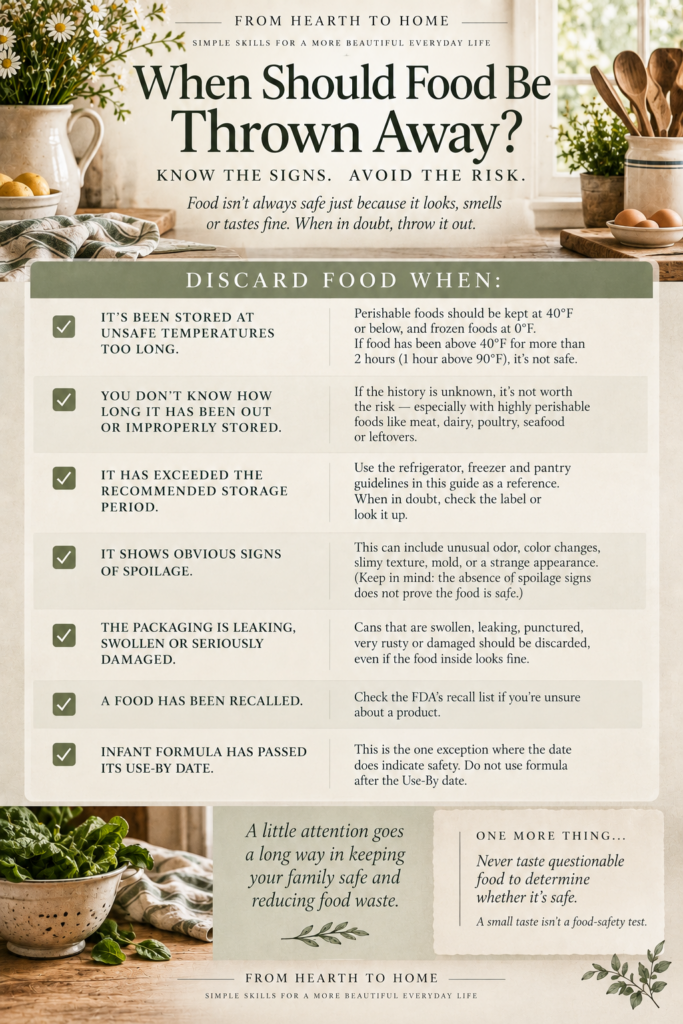
When Should Food Definitely Be Thrown Away?
There are times when the sensible answer is simply:
Throw it out.
Discard a perishable food when you know it has been stored at unsafe temperatures too long.
Throw it away when you don’t know how long it has been sitting out or improperly stored.
Pay attention when a food has exceeded its recommended refrigerated storage period.
Discard food with obvious signs of spoilage, and don’t use food from leaking, swollen or seriously damaged packaging.
If a food has been recalled and the product you own matches that recall, follow the recall instructions.
And remember that infant formula should not be used after its Use-By date.
There is one more rule I want to emphasize:
Never taste questionable food to determine whether it’s safe.
A tiny taste isn’t a food-safety test.
If the storage history of a highly perishable food is unknown and you’re genuinely unsure whether it has been handled safely, this isn’t the place to save 75 cents.
Throw it away.
So What About My Buttermilk?
Which brings me back to that half gallon of buttermilk sitting in my refrigerator.
Seeing September 12 printed on the carton didn’t actually answer the question I thought it answered.
The better questions were:
What kind of date is September 12?
How long has the buttermilk been open?
Has it stayed properly refrigerated?
What does reliable storage guidance say about this particular food?
Is there any reason to believe it has spoiled or hasn’t been handled safely?
That’s a much more useful way to think about food dates.
Instead of treating every printed date like an automatic command to throw food away, we can learn what those dates mean and use good storage practices to make sensible decisions.
And instead of assuming something must be safe because it still looks fine, we can pay attention to storage time and temperature too.
Good Food Management Is Part of Running a Home Well
Knowing how to store food isn’t particularly glamorous.
It’s one of those quiet homemaking skills that doesn’t look like much until you realize how often you use it.
Knowing that tonight’s leftovers need to go into the freezer because nobody will eat them in time saves food.
Knowing that a Best By date doesn’t automatically mean throw this away can save money.
Knowing when a questionable food isn’t worth the risk protects the people we feed.
And learning these small skills, one at a time, makes us more capable in our own kitchens.
That’s really what good homemaking is about.
Not doing everything perfectly.
Just knowing a little more today than we did yesterday—and using what we know to take good care of the people and resources entrusted to us.
From my hearth to yours,
Becky
Helpful Food-Safety Resources
For foods that aren’t included in this guide—or anytime you’re uncertain about a particular food—check the official FoodSafety.gov Cold Food Storage Chart and FDA food-storage guidance rather than guessing.
This article is intended as general household food-storage information and is based on current USDA, FDA and FoodSafety.gov guidance. When in doubt about a particular food, consult current official food-safety guidance.
Leave a Reply