
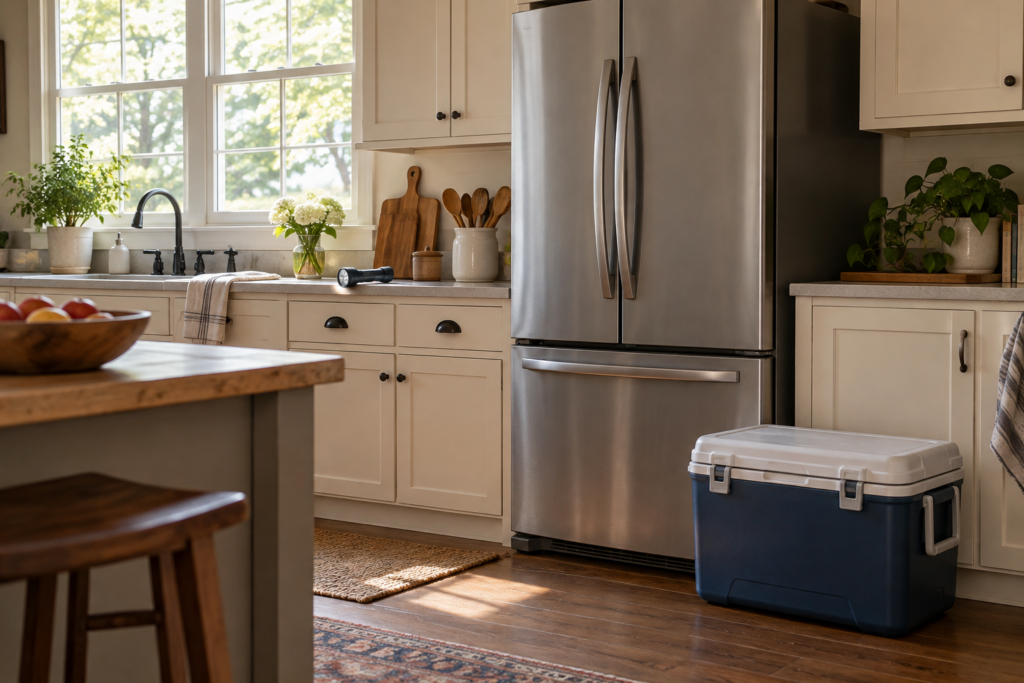
When you have a freezer full of meat, losing power can make you think about your grocery budget pretty quickly. We have two freezers, and protecting that food is one of my first concerns when the lights go out.
Here in Wisconsin, we lose power in summer as well as winter, sometimes for a few hours and sometimes for a day. We have a generator, which has helped us protect our food. But even with a backup plan, it helps to know what to do first.
Whether you’re dealing with an ice storm or a summer outage, the priorities are the same: keep food cold, track the time, and make decisions based on temperature rather than guesswork.
What to Do First When the Power Goes Out
- Write down when the power stopped. You’ll need that time when deciding what to do next.
- Keep the refrigerator and freezer doors closed. Avoid opening them repeatedly to check the food.
- Get your cooler and ice packs ready. If the outage looks likely to last, plan to move refrigerated perishables before they become too warm.
- Plan one simple meal. Use safely chilled perishables you can prepare now, and gather what you need in one trip.
USDA guidance recommends keeping cooler food at 40°F or below with ice or frozen gel packs.
How Long Will the Fridge and Freezer Stay Cold?
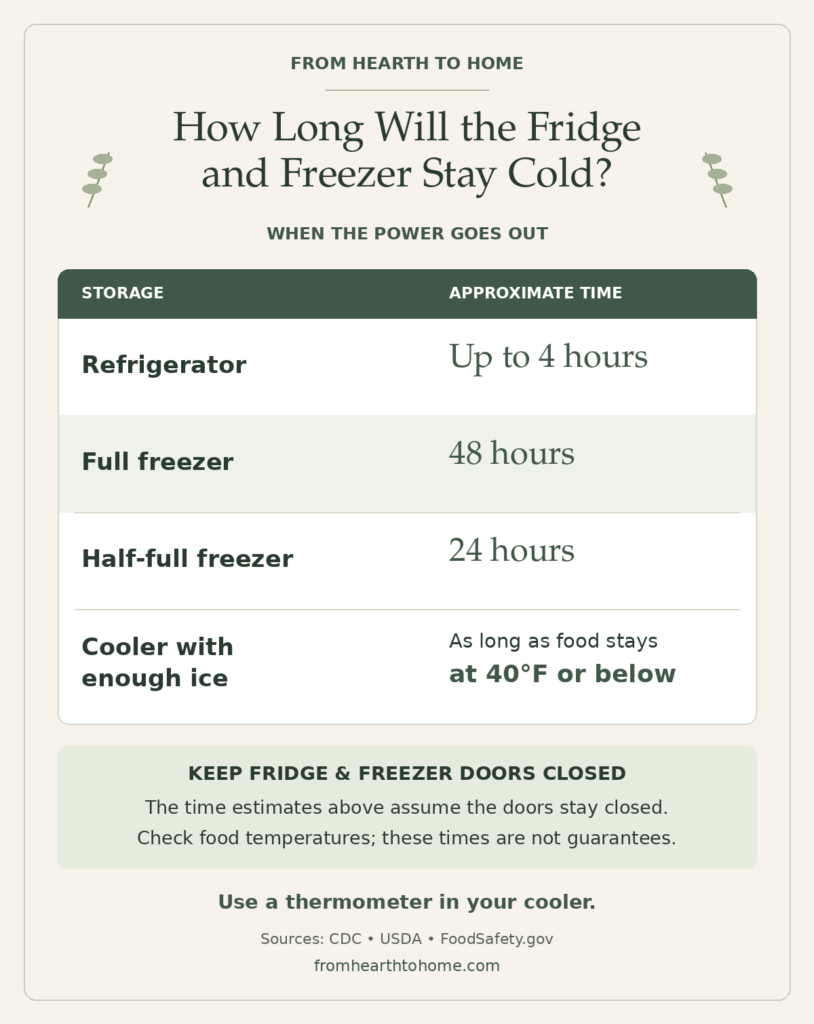
Screenshot this chart so you have the time limits handy if the power goes out.
Fridge and freezer estimates assume the doors stay closed. These are planning windows, not a guarantee for every appliance or food item.
The CDC’s power outage guidance gives these fridge and freezer time limits. Your freezer’s manufacturer may provide an estimate for your particular model, but food temperatures still matter when deciding what is safe.
The Four-Hour Fridge Window and the Two-Hour Rule
These numbers describe different things.
Four hours is approximately how long an unopened refrigerator can keep food cold without power.
Two hours is the limit for many perishables once they have warmed above 40°F. That time may start before the four-hour window ends if the fridge was already warm or the door keeps opening.
The FDA’s thermometer guidance explains why temperature matters. If you cannot establish how long food has been too warm, discard it.
Once an outage reaches four hours, discard refrigerated perishables unless you can establish that they have remained safely cold—for example, through reliable temperature monitoring or timely transfer to an iced cooler.
For food sitting out without temperature control, the usual two-hour limit drops to one hour when the surrounding temperature is above 90°F. This matters during summer outages, too.
For everyday meals, groceries, and cookouts, see How Long Can Food Safely Sit Out? A Homemaker’s Guide to the Two-Hour Rule.
Use Perishables Early, While They’re Still Safe
If I expect a longer outage and think I may not be able to keep everything cold, I would plan our next meal around the perishables first.
That might mean lunch-meat sandwiches or scrambled eggs, provided the ingredients have stayed safely cold and I have a safe way to cook.
Using those foods early can reduce waste. It doesn’t mean eating everything immediately or leaving the fridge open while deciding. Make a plan, gather what you need, and close the door again.
Cooking or reheating cannot reliably rescue food that has already been held at an unsafe temperature for too long. The FDA warns that inadequately chilled perishables can cause illness even after thorough cooking.
How to Protect Food in a Cooler
Prepare the cooler before opening the refrigerator. Add ice or frozen gel packs, then transfer food while it is still safely cold.
Use a thermometer to check that the cooler stays at 40°F or below. Add more ice as needed and open the lid as little as possible.
Keep raw meat sealed and separate from ready-to-eat foods so leaking juices cannot contaminate them.
Don’t automatically empty a still-frozen freezer into coolers. A closed freezer may be your best cold storage for the moment.
These steps follow USDA emergency food guidance.
Can You Put Food Outside During a Winter Outage?
In Wisconsin, it’s tempting to think the outdoors could take over for the refrigerator.
But winter air is unreliable food storage. Temperatures fluctuate, sunlight can warm food even on a cold day, and animals can reach unprotected packages.
USDA recommends using freezing weather to make ice instead. Freeze clean water in suitable containers outdoors, then use that ice in a cooler.
If a cooler is outside, rely on ice and a thermometer to establish that food stays at 40°F or below. Protect it from animals and contamination. A cold weather forecast alone does not tell you the temperature of the food inside.
What Refrigerated Food Should You Discard?
Screenshot this quick reference along with the time limits above.
This chart applies after the foods below have been above 40°F for more than two hours.
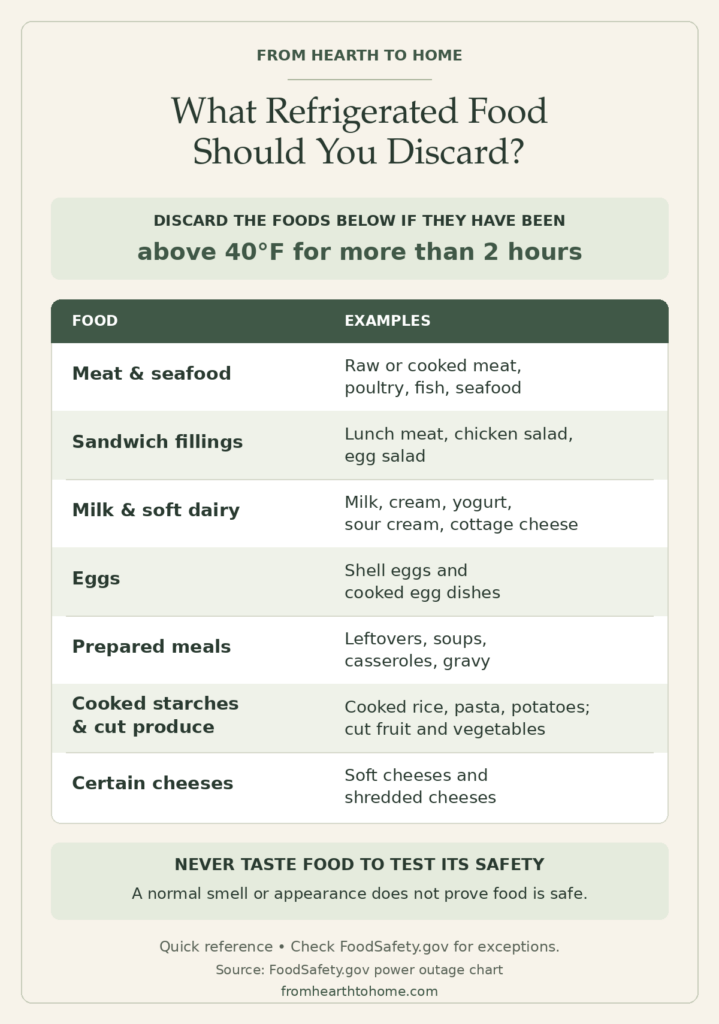
Some foods, including butter, blocks of hard cheese, whole uncut produce, bread without perishable fillings, peanut butter, and jelly, can generally be kept under the conditions in the FoodSafety.gov chart.
Check that chart for individual foods and exceptions. This short list does not cover every item.
Never taste food to decide whether it is safe. A normal smell or appearance does not prove safety.
Can You Refreeze Meat After an Outage?
According to USDA, meat that still contains ice crystals or remains at 40°F or below can be refrozen. Its texture or quality may change.
Discard meat that has been above 40°F for more than two hours. If you cannot establish its temperature history, don’t guess.
Other frozen foods have their own exceptions. For example, FoodSafety.gov advises discarding ice cream and frozen yogurt; use its full chart when sorting the freezer.
When the Power Comes Back On: A Food Safety Checklist
Before settling back into your routine, take a few minutes to assess the food.
- Check promptly. Look at appliance thermometers and check food temperatures before cooling resumes enough to hide how warm the food became.
- Review the outage time and any temperature records. A cold reading after the fridge has been running again cannot establish that food stayed safe throughout the outage.
- Sort food item by item. Use the fridge and freezer guidance above and the FoodSafety.gov chart. Discard unsafe perishables or those with an uncertain storage history.
- Refreeze eligible frozen foods. Meat with ice crystals or a temperature of 40°F or below can be refrozen; check the chart for exceptions among other foods.
- Check normal storage temperatures before restocking. Confirm the refrigerator is at 40°F or below and the freezer is back to 0°F or below.
These checks draw on FDA thermometer guidance and the FoodSafety.gov outage chart.
Safely stored leftovers still have their original storage limits. An outage does not give them a new storage window. For help keeping track, see How Long Do Leftovers Last? A Homemaker’s Guide to Safe Storage and Reheating.
Simple Meals Until the Power Returns
I wouldn’t expect to make an elaborate meal during an outage. My pantry would help us get through it with something simple:
- Peanut butter and jelly sandwiches.
- Crackers, whole fruit, nuts, or granola bars.
- Canned soup with crackers, if we have a safe way to heat it.
- Lunch-meat sandwiches while the meat remains safely chilled.
- Scrambled eggs, if the eggs are safely cold and cooking is possible.
We have a small butane stove as another option for simple cooking. Portable camping stoves and grills must be used outdoors, away from doors, windows, and vents—not in the house or garage. Follow the appliance instructions. If conditions make outdoor cooking unsafe, choose food that doesn’t need heating.
The CDC warns about carbon monoxide from fuel-burning equipment. Portable generators also belong outdoors, at least 20 feet from doors, windows, and vents, with a working battery-backed carbon monoxide detector inside.
A pantry stocked with familiar foods helps during an outage and on ordinary busy days. For help building yours gradually, read How to Build a Pantry System That Saves Money on Groceries: A Beginner’s Guide.
Join the Home Journal

Caring for a home means learning practical things like this along the way. If you’d like more simple homemaking ideas, recipes, and encouragement for real life, I’d love to have you join the Home Journal.
Each Friday, I share what’s happening around our home, along with practical ideas you can use in yours.
A Little Preparation Before the Next Outage
Keep appliance thermometers in your refrigerator and freezer, a food thermometer available, and a cooler with frozen packs ready. Normal storage temperatures are 40°F or below in the fridge and 0°F or below in the freezer, according to FDA guidance.
Add a manual can opener and a few familiar foods that can be eaten without cooking. Keep this guide where you can find it, or screenshot the charts before you need them.
I know how frustrating it would be to lose meat or groceries you’ve worked hard to purchase. Protect what you can, use food while it’s still safe, and let reliable time and temperature information guide the rest.
Start where you are. Care for what you have.
From my hearth to yours,
Becky
Leave a Reply