
There are certain questions I simply do not want to answer every day.
What are we having for dinner?
Do I need to do laundry?
When am I going grocery shopping?
What should I clean first?
Do we have enough milk?
What absolutely needs to get done today?
None of these decisions is particularly difficult. The problem is having to make them again and again.
Add those little questions to appointments, work, caregiving, errands, bills, family needs, and all the unexpected things that come with ordinary life, and suddenly it can feel as though you’re managing a hundred open tabs in your head.
That is one of the reasons I have come to appreciate simple routines and household defaults so much.
Not because I want every hour of my life scheduled.
Quite the opposite.
A good homemaking routine should give you fewer things to think about, not more.
After more than thirty years of keeping a home, I have found that some of the best household systems are simply decisions I made once so I don’t have to keep making them over and over again.
Homemaking Comes With Hundreds of Small Decisions
We often talk about the physical work involved in homemaking—the laundry, cooking, cleaning, grocery shopping, and everything else that keeps a household going.

But there is another kind of work happening quietly in the background.
Someone has to notice.
We’re getting low on milk.
Those towels need washing.
There isn’t enough chicken for Thursday’s dinner.
The bathroom needs attention.
We’re almost out of toothpaste.
Someone needs clean pants tomorrow.
None of these things is particularly dramatic. That’s precisely what makes them so easy to underestimate.
Individually, they’re tiny decisions. Collectively, they can make you feel as though your brain never quite gets to clock out.
I’ve learned that I don’t need a complicated system for every one of them.
I just need to stop making the same decisions repeatedly.
Decide What’s for Dinner Once
So I don’t.
Dinner is probably the household decision that would annoy me the most if I had to make it every single day.
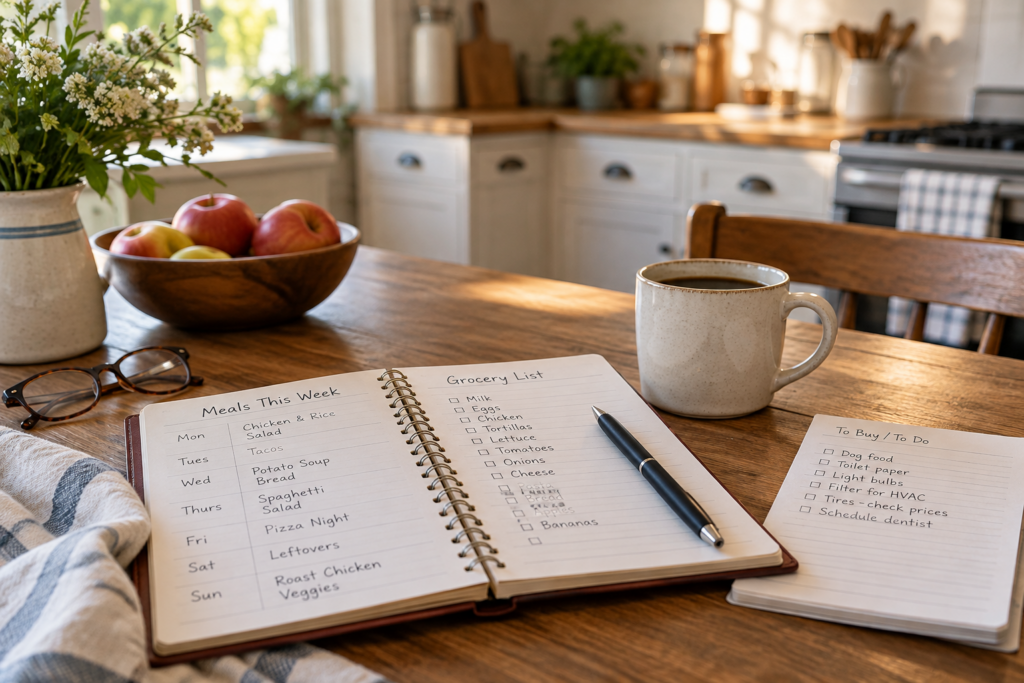
On Sundays, I sit down for about ten minutes and make a meal plan for the coming week.
I look at our calendar first. If we have something going on one evening, I’m certainly not planning an elaborate dinner that night. Then I look at what I already have in the pantry and freezer and build our meals around that.
Anything we’re missing goes onto my grocery list.
And that’s it.
I make the dinner decisions once.
I have no interest in holding a committee meeting with myself every afternoon at four o’clock about what we’re having for dinner.
The meal plan can change. It frequently does. Tuesday’s dinner can become Wednesday’s dinner. We can decide we’d rather have frozen pizza. Nothing terrible happens.
The purpose of the plan isn’t to control the week.
The purpose is to give me an answer when I need one.
That’s an important distinction.
If deciding what’s for dinner is one of the things that trips you up every week, you may also find my [Simple Weekly Meal Planning] guide helpful.
Give Repetitive Jobs a Default
Laundry is another good example.
I generally do one load a day as needed, or sometimes every other day.
That’s enough to keep things moving without creating an entire Laundry Day that takes over my life.
I don’t particularly enjoy having baskets of clothing everywhere, trying to remember which load needs switching, and spending an entire day feeling as though I’ve somehow become an employee of the washing machine.
One load is manageable.
Then I move on.
Your default doesn’t have to be mine. A larger family might need two loads a day. Someone else may genuinely prefer doing everything on Saturday.
The particular routine matters less than having an answer to the recurring question:
When do we do laundry around here?
Once you’ve answered that, stop renegotiating it with yourself.
If laundry is one of those household skills you were never really taught, you can start with my [How to Sort Laundry] guide.
Not Everything Needs a Schedule
This is where I think homemaking advice can sometimes make life harder than it needs to be.
I don’t have every cleaning task assigned to a particular day anymore.
At this stage of my life, I tend to clean according to what needs attention and how much time I have.
If I notice the bathroom needs a good cleaning and I have half an hour, I’ll clean the bathroom.
If the house looks messy and I have ten minutes, I’ll put things away and straighten up.
If the carpet is covered in dog hair and I have fifteen minutes, I’ll vacuum.
That’s a routine too.
It just doesn’t come printed on a color-coded chart.
There is a fairly large distance between keeping a reasonably clean home and maintaining a house that looks as though no one has ever sat down in it.
I spent more time aiming for the latter when I was younger.
It turns out people insist on living in the house.
I still like a clean home. I still want things reasonably picked up and cared for. I’ve simply stopped believing that everything needs to be perfect at the same time.
Keep Basics on Hand So Every Shortage Isn’t an Emergency
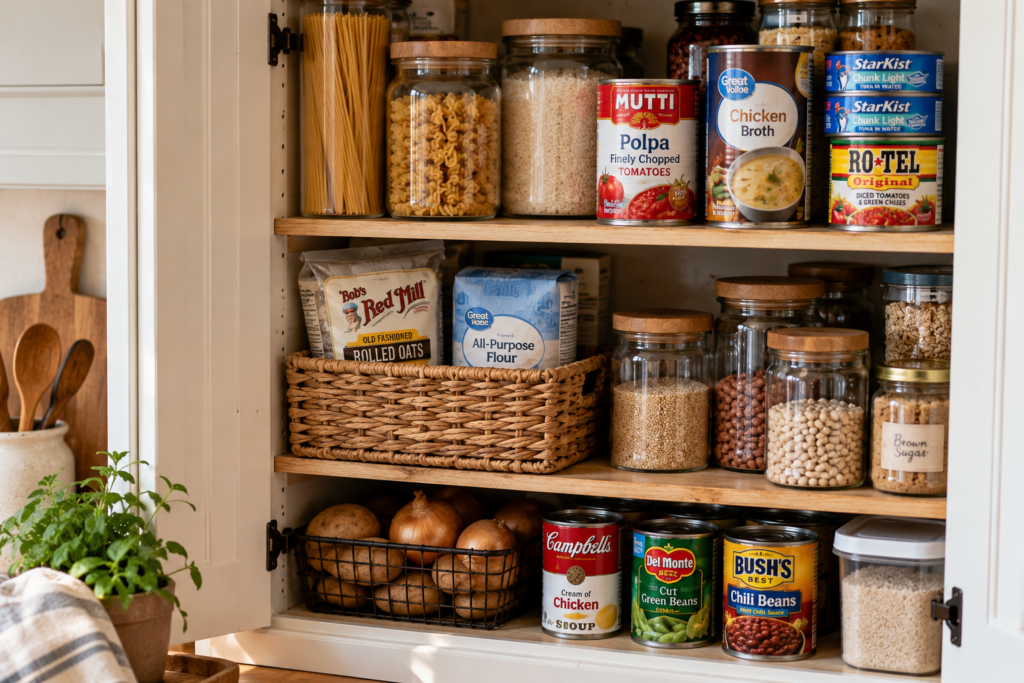
One of my longest-standing household defaults is keeping a useful pantry and freezer.
I keep the foods we regularly use on hand and replace things as we go through them.
That means if Thursday comes around and grocery shopping simply isn’t happening, we still have dinner.
It might be soup and bread.
It might be pasta.
It might be something from the freezer.
It might even be frozen pizza.
We’re going to survive.
I don’t need to make an emergency trip to the store simply because life didn’t cooperate with my grocery-shopping plans.
A stocked pantry isn’t only about saving money or preparing for shortages.
For me, it also removes decisions.
It answers the question:
What happens if I can’t get to the store?
We eat what we have.
Problem solved.
If you’re trying to create that kind of cushion without buying everything in sight, you may also enjoy [How to Stock Your Pantry for Fall Without Spending a Fortune] and [How to Make Groceries Stretch Without Feeling Deprived].
Have a Place for Things You Know You’ll Need to Deal With
The same principle works with household purchases.
If I notice something ordinary that we’re running low on, it goes on a list. I don’t try to remember it for three days.
For bigger expenses—tires, repairs, household replacements—we try to look ahead. We can compare prices and start setting money aside rather than waiting until something becomes an emergency.
You can’t anticipate everything.
Water heaters apparently don’t consult your calendar before deciding they’ve had enough.
But plenty of household needs are predictable.
Taking care of those decisions before they’re urgent removes an enormous amount of unnecessary stress.
Decide What Matters When You Can’t Do Everything
This may be the most useful default I have.
There are days when everything isn’t getting done.
Sometimes life is busy. Sometimes you’re exhausted. Sometimes someone needs you. Sometimes the day simply goes sideways.
On those days, I don’t need to stand in the middle of the house trying to decide which of the seventeen things bothering me deserves my attention first.
I already know.
Take care of the people.
Does everyone have what they need?
Is everyone fed?
Are medications taken care of?
Does someone need particular clothing washed?
Is there something that genuinely has to happen today?
Take care of that first.
The bathroom can be cleaned tomorrow.
The carpet will survive another day.
The laundry that nobody needs immediately can wait.
That doesn’t mean I’ve stopped caring for my home.
It means I’ve decided what the home is for.
If you’re in one of those seasons when even the basics feel like a lot, you may also find [Too Tired to Keep Up With the House? What to Do First] helpful.
Homemaking for Real Life—Not Perfect Life
If you enjoy practical homemaking, useful household skills, simple recipes, and a little encouragement for making the most of the home you have, I’d love to have you join me for The Home Journal.
Each Friday, I share something useful for the kitchen or home, what I’ve been working on lately, and a few thoughts about making ordinary life a little easier and more enjoyable.
No perfect house required.
Your Minimum Does Not Have to Look Like Someone Else’s Maximum
When I was younger, I had a different idea of what successful homemaking looked like.
I thought the house should be perfectly clean, everything should be decorated beautifully, everything should be caught up, and somehow all of it should remain that way.
That’s exhausting.
It’s also rather difficult when actual human beings keep opening cupboards, wearing clothes, eating food, and generally interfering with the display.
I still believe a home should be cared for.
But I’ve learned there is a difference between caring well for something and demanding perfection from it.
Some seasons allow you to do more.
Some allow you to do less.
A useful routine has enough structure to keep ordinary life moving while leaving enough flexibility for actual life to happen.
Five Household Decisions You Could Make Once This Week
You don’t need to overhaul your entire household.
Instead, look for one ordinary question you’re tired of answering and decide whether you can give it a default.
Here are five places you might start:
Choose your usual grocery-shopping day. It can change when necessary, but give it a normal place in the week.
Choose three to five backup dinners. Keep the ingredients around for meals you can make without much thought.
Decide when laundry happens. Don’t wait until you’re staring at a mountain of it and wondering where all the underwear went.
Decide what your minimum is on an exhausting day. What truly needs to happen, and what can wait?
Keep one running household list. When something needs replacing or buying, put it there instead of carrying it around in your head.
And please don’t read this list and immediately create five new rules for yourself.
That would rather defeat the purpose.
Pick one decision you’re tired of making and start there.
Make the Decision Once

If there is an ordinary household question you find yourself answering again and again, try noticing it this week.
Not because you need another elaborate system.
Ask yourself:
Could I answer this once?
Maybe Tuesday becomes your regular laundry day.
Maybe you always keep ingredients for three emergency dinners.
Maybe grocery pickup happens every Thursday.
Maybe sheets get washed every other Friday.
Maybe you decide that when the house feels overwhelming, you start with dishes and a ten-minute pickup.
Maybe you keep a short list of five dinners everyone will eat when you don’t know what else to make.
These aren’t rules.
They’re defaults.
You can change them whenever they stop serving your household.
Their job is simply to prevent ordinary life from requiring a brand-new decision every single time.
For more practical examples of simple household systems, you can also read [10 Simple Home Systems That Save Time Every Day].
A Routine Should Make Life Lighter
I don’t want homemaking systems that require me to spend my life maintaining the system.
I want systems that quietly answer questions in the background.
What’s for dinner?
Already decided.
When do I grocery shop?
Usually Thursday.
What if I can’t shop?
There’s food in the pantry.
When does laundry happen?
A load at a time, before it becomes a mountain.
What gets done when I’m overwhelmed?
The people get what they need first.
And what about everything else?
We’ll get to it.
That may be one of the best things a homemaking routine can give us—not a perfectly controlled home, but less mental noise inside an ordinary one.
You don’t need to decide everything every day.
Some questions have already been answered.
Let them stay answered.
From my hearth to yours,
Becky
Leave a Reply