
Part of The Homemaker’s Skill Book
This article is part of The Homemaker’s Skill Book, a growing collection of practical lessons for anyone who wants to feel more capable at home. Many of us were never taught the small, everyday skills that help a household run well—and there is no shame in learning them now. We’ll begin with the basics, explain why they matter, and build useful homemaking knowledge one skill at a time.
Laundry detergent is a good example of an everyday product many of us use by habit. We pour it into the cap, perhaps add fabric softener, and start the machine without knowing why we are using those amounts—or whether all those products are necessary.
Using extra detergent does not necessarily produce cleaner laundry. Too much can leave residue behind, make towels less absorbent, contribute to odors, and prevent a washing machine from rinsing properly.
Good laundry care is not about using more products. It is about looking at the load in front of you, choosing what it actually needs, and using each product correctly. This guide will help you measure detergent, recognize signs of overuse, and decide which additional laundry products are useful, optional, or best avoided on certain fabrics.
If you are beginning with the fundamentals, you may also want to read How to Sort Laundry: A Simple Beginner’s Guide and How to Use a Washing Machine: A Simple Beginner’s Guide.
The Quick Answer: How Much Laundry Detergent Should You Use?
Use the smallest amount recommended on your detergent label for your washer type, load size, and soil level. Add more only when the product directions call for it—for example, for a genuinely large or heavily soiled load.
There is no single measurement that is correct for every detergent. Today’s formulas are sold in different concentrations, including 2X, 4X, 8X, and other formulations. Two bottles that appear similar may require very different amounts per load.
For that reason, do not automatically fill the detergent cap. Find the dosage chart on the bottle or package and look closely at the measuring lines inside the cap. The cap’s full capacity is not necessarilyt the amount intended for one ordinary load.
As a general reference, a normal load in a high-efficiency washer commonly uses about 2 tablespoons of HE detergent. That is a useful starting point, but the directions for your particular detergent and washing machine should take precedence.
Before Starting the Washer, Check Four Things
- Is the washing machine high-efficiency or conventional?
- How concentrated is the detergent?
- How large and dirty is the load?
- Is the household water hard, soft, or somewhere in between?
These factors matter more than the size of the detergent cap.
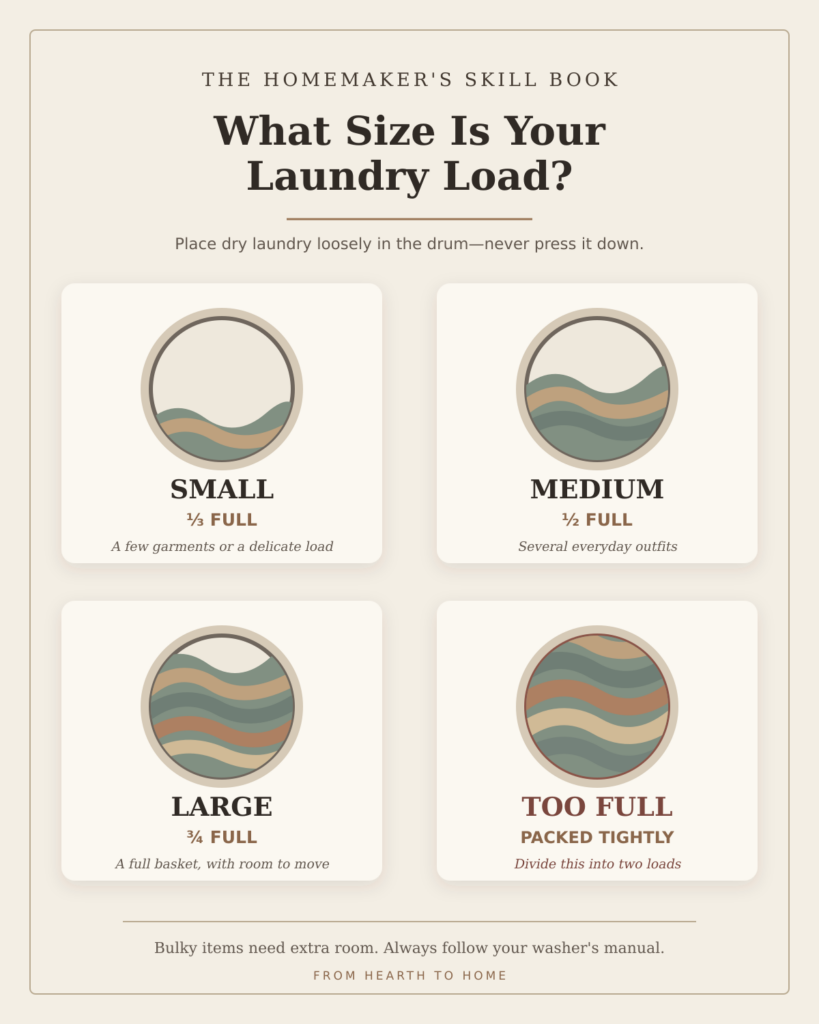
What Is a Small, Medium, or Large Load of Laundry?
Detergent directions often refer to load size without explaining what that looks like inside the washer. Because washing-machine capacities and designs vary, use these measurements as a visual guide rather than an exact formula.
Clothing should rest loosely in the drum rather than being pressed or packed into it. Items need room to move through the wash water so detergent can reach the fabric and soil can rinse away.
An overfilled washer may leave clothing poorly cleaned even when plenty of detergent has been added. Before blaming the detergent, make sure the machine is not simply too full.
How to Determine the Correct Amount of Detergent
1. Check the Washer Type
High-efficiency washing machines use less water and require detergent marked with the HE symbol. HE detergent is formulated to produce fewer suds in a low-water machine.
Regular detergent can create too many suds in an HE washer. This may interfere with cleaning and rinsing, lengthen the cycle, or cause operational problems. If your machine requires HE detergent, use it every time.
Some modern washers have automatic bulk dispensers. If yours does, make sure the machine’s concentration setting matches the detergent you poured into the reservoir. Follow the washer manual for filling and cleaning the dispenser.
2. Read the Detergent Concentration
Look for terms such as concentrated, ultra-concentrated, 2X, 4X, or 8X on the package. A small amount of a highly concentrated formula may clean the same size load as a larger amount of a less concentrated formula.
Never assume that the measurement you used with your last bottle will be correct for a new one.
3. Consider the Size and Condition of the Load
An ordinary load of lightly worn clothing generally requires less detergent than muddy work clothes, greasy kitchen linens, or heavily soiled bedding.
Treat visible stains before washing instead of pouring extra detergent into the entire load. Pretreatment places the cleaning product where it is needed most.
4. Consider the Water
Hard water contains minerals that can make it more difficult for detergent to work effectively. Very soft water generally requires less detergent and can produce excess suds more easily.
If you do not know your water hardness, check your municipal water report, ask your water utility, or use an inexpensive test strip. Homes with private wells can test their water directly.
If a water softener is installed, detergent should be measured for the softened water coming into the machine—not the untreated water.
In our home, we have well water and use a water softener, so I have learned that detergent cannot be measured by load size alone. The water coming into the washer matters too. Once water has been softened, using the same amount recommended for untreated hard water may create too many suds and leave detergent behind.
Why More Detergent Does Not Mean Cleaner Laundry
Detergent loosens soil and helps suspend it in the wash water so it can be rinsed away. For that process to work, the washer needs the correct balance of detergent, water, movement, and rinsing.
I have also seen what too much detergent can do to the inside of a washing machine. It can create a gummy, grimy buildup that holds onto soil and contributes to unpleasant odors.
When the washer cannot rinse the excess detergent away completely, residue may remain inside the machine and in the fabric along with the dirt it was meant to remove. All in all, too much detergent is not good for your clothing or your washing machine.
Look for patterns rather than judging the amount of suds during one unusual load. You may be using too much detergent if:
- The washer frequently produces excessive suds.
- Clothes have chalky streaks, colored spots, or visible residue.
- Fabric feels sticky, waxy, stiff, or rough after drying.
- Towels have gradually become less absorbent.
- The detergent drawer or drum feels slimy.
- The washing machine develops a musty odor.
- Clothing does not seem thoroughly rinsed.
- Loads come out unusually wet because excess suds affected the spin cycle.
To correct the problem, begin using the detergent’s lowest recommended dose for an ordinary load. Clean the detergent dispenser and run the machine’s cleaning cycle according to its use-and-care manual rather than making up your own washer-cleaning mixture.
An extra rinse can help with a load that still contains visible residue, but routinely needing one may be a sign that the detergent amount or load size needs to be corrected.
Using the correct amount also saves money. Pouring twice as much detergent does not provide twice the cleaning power; it simply empties the bottle twice as quickly.
Liquid, Powder, Pods, or Detergent Sheets?
The best choice is the one that works reliably in your machine, suits your household, and can be measured or used correctly.
| Detergent type | Advantages | Things to consider |
| Liquid | Easy to measure and useful for pretreating many greasy or oily stains | Very easy to overpour; spills can be messy |
| Powder | Often economical and easy to adjust for different load sizes | Must dissolve properly; follow washer directions for placement |
| Pods or pacs | Convenient and premeasured | Difficult to reduce for a small load; must be placed correctly and stored securely |
| Detergent sheets or tiles | Compact and easy to store | Directions and cleaning performance vary by product |
Single-dose products are not all the same size or concentration. Follow the specific package directions rather than assuming every load always needs one—or that a large load automatically needs several.
Laundry pods should generally be placed in the empty washer drum before the clothing is added, not in the liquid-detergent dispenser, unless the washer has a dispenser specifically designed and labeled for them.
Keep detergent—especially colorful single-dose pods—closed in its original container and stored securely away from children, pets, and anyone who might mistake it for something edible.
Where Does Each Laundry Product Go?
Washer designs vary, so the machine manual and product label always come first. The following guide shows the usual placement for common laundry product
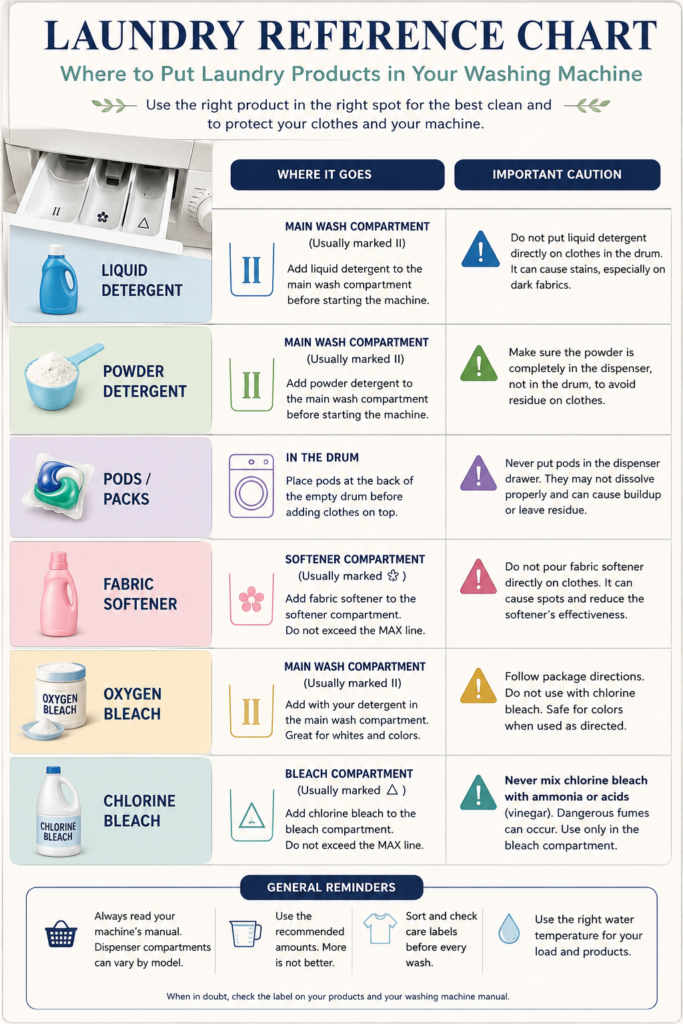
If the dispenser compartments are not clearly marked, pause and find the washer manual. Putting the right product in the wrong compartment can release it at the wrong point in the cycle.
Do You Need Fabric Softener?
Fabric softener is optional. It coats fibers to provide a softer feel, fragrance, and some static reduction, but it is not necessary for cleaning.
If you enjoy using liquid fabric softener, measure it according to the product directions and add it only to the designated dispenser. Do not pour concentrated softener directly onto dry clothing, where it may leave spots.
Fabric softener can reduce or interfere with the useful properties of certain materials. Check the care label and generally avoid it on:
- Bath and kitchen towels, because it can reduce absorbency
- Microfiber cleaning cloths
- Moisture-wicking and performance fabrics
- Flame-resistant garments, including some children’s sleepwear
- Any item whose care label warns against it
A product that makes an ordinary cotton shirt feel softer may make a towel or cleaning cloth perform less effectively. Choose it according to the fabric rather than adding it automatically to every load.
Dryer Sheets, Wool Dryer Balls, or Neither?
No dryer additive is required for clean laundry. These products address drying time, static, softness, or fragrance—not washing.
Dryer Sheets
Dryer sheets can reduce static, soften the feel of some fabrics, and add fragrance. Because they leave a light coating, skip them on towels, microfiber, moisture-wicking clothing, and other items whose performance depends on absorbency.
If you use them, begin with the smallest number recommended for the load. More sheets do not necessarily produce a better result.
Wool Dryer Balls
Wool dryer balls help separate items as they tumble and may help a load dry more evenly. They are reusable and fragrance-free unless a scent is added.
They may reduce static in some loads, but they will not eliminate it under every condition—particularly in very dry weather or when synthetic fabrics are overdried.
Neither
It is perfectly acceptable to dry laundry without sheets or dryer balls. If static is not a problem, there is no reason to add a product merely out of habit.
The Basics of Pretreating Laundry Stains
Stains are best handled individually. Adding extra detergent to the entire washer is not a substitute for treating the stained area.
Use this basic method:
- Treat the stain as soon as reasonably possible.
- Read the garment’s care label.
- Gently lift or blot away any excess material without spreading the stain.
- Apply a stain treatment appropriate for the stain and fabric.
- Let it work for the amount of time directed on the label.
- Wash the item according to its care instructions.
- Inspect the stained area before putting it in the dryer.
Dryer heat can make some stains much more difficult to remove. If the stain remains, treat and wash the item again rather than drying it.
This is intentionally a basic method. Blood, grease, ink, rust, makeup, grass, and food stains do not all respond to the same treatment. A complete stain-removal guide is a separate homemaking skill worth learning.
Oxygen Bleach Versus Chlorine Bleach
The word bleach is used for two different categories of laundry product, and they are not interchangeable.
Oxygen Bleach
Oxygen bleach is a non-chlorine product commonly used to soak, brighten, and help remove stains from many washable fabrics. Some products are suitable for colorfast items as well as whites, but the label and garment-care instructions must be checked first.
Oxygen bleach often needs time to work and must be dissolved and used according to its package directions. Do not assume that adding an unmeasured scoop to every load will improve ordinary laundry.
Chlorine Bleach
Chlorine bleach is stronger and should be used only on fabrics and colors that allow it. Check both the garment label and the bleach label. Measure it carefully and use the washer’s designated bleach dispenser so it can be diluted and released properly.
Never pour chlorine bleach directly onto clothing.
Laundry safety: Never mix chlorine bleach with ammonia, vinegar, acids, or other household cleaners. Dangerous gases can form. Use products only as labeled and keep the area ventilated.
Bleaching and sanitizing are not the same as routine cleaning. Most ordinary household laundry does not need to be sanitized during every wash.
If Your Laundry Still Is Not Coming Clean
Do not immediately add another capful of detergent. Work through the load as a system.
Was the Washer Overloaded?
Clothing needs room to move. Divide an overfilled load and wash fewer items at a time.
Were Visible Stains Pretreated?
Routine detergent may not remove a concentrated stain without help.
Was the Correct Cycle Selected?
A quick or delicate cycle may not provide enough time or agitation for heavily soiled laundry. Match the cycle to both the fabric and the soil level.
Was the Water Temperature Appropriate?
Follow garment labels and detergent directions. Cold water protects many fabrics and saves energy, but some soils, products, and sanitation needs call for a different temperature.
Is the Detergent Compatible With the Washer?
An HE washer needs HE detergent. Confirm that an automatic dispenser is set for the detergent’s actual concentration.
Does the Washer Need Maintenance?
Clean the dispenser, filter, gasket, and washing machine according to the manufacturer’s instructions. A dirty machine cannot consistently produce fresh laundry.
Could the Water Be Affecting the Result?
Hardness, softness, mineral content, and water temperature can influence detergent performance. If the problem affects every load, consider testing the water rather than continually increasing the detergent.
Which Laundry Products Do You Actually Need?
The laundry aisle can make it appear that every load requires five or six different products. It does not.
Essential
- A dependable detergent appropriate for your washing machine and household laundry
Helpful for Particular Needs
- A stain pretreatment
- Oxygen bleach for suitable fabrics, soaking, brightening, or stain removal
- Chlorine bleach for specific bleach-safe laundry and uses
Entirely Optional
- Liquid fabric softener
- Dryer sheets
- Wool dryer balls
- Scent beads
- Fragrance boosters
- Laundry sanitizer for ordinary loads
Optional does not mean bad. It simply means the product should earn its place in your laundry routine.
If it solves a real problem or gives you a result you enjoy, use it correctly. If it does not, you can leave it on the store shelf.
What to Use for Common Laundry Loads
Different fabrics need different care. A product that works well on an everyday cotton shirt may reduce the performance of a towel, microfiber cloth, or moisture-wicking garment.
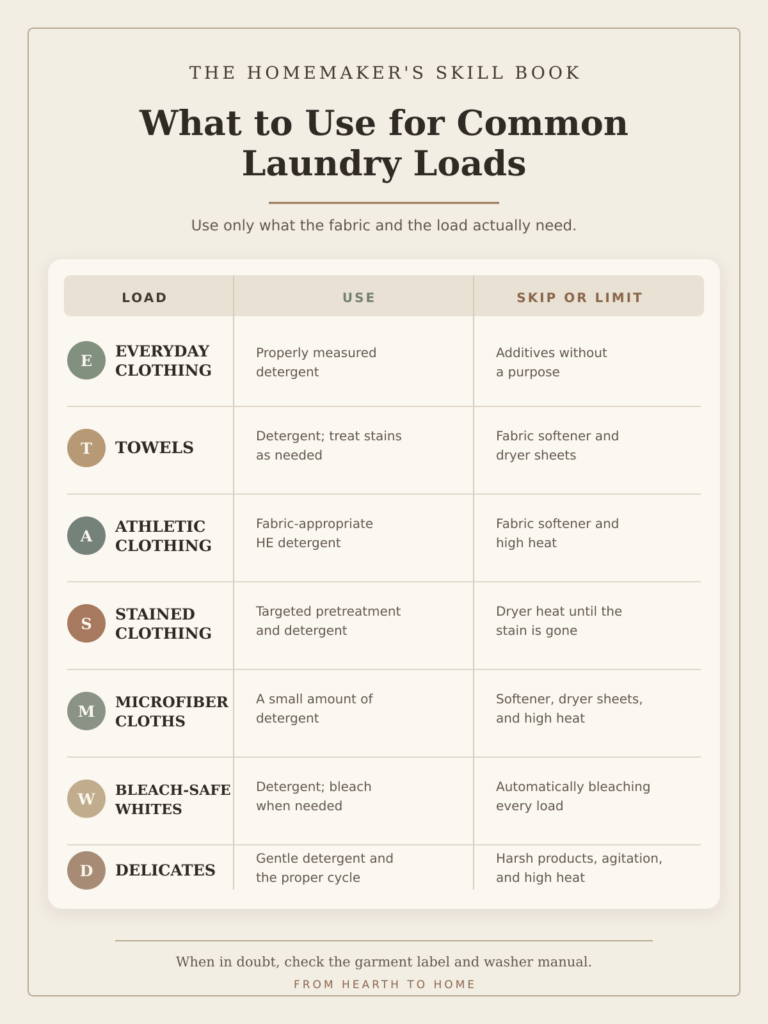
Always allow the garment-care label and product directions to overrule a general guide.
A Simple Laundry-Product Routine
The same short decision process can be used for nearly every load:
- Check the clothing. Empty pockets, fasten or protect items as needed, and read unfamiliar care labels.
- Look for stains. Pretreat visible spots before loading the machine.
- Load loosely. Leave enough room for laundry to move through the wash.
- Measure the detergent. Use the label amount that matches the washer, concentration, load size, and soil level.
- Add only what the load needs. Softener, bleach, and other additives are not automatic requirements.
- Choose the appropriate cycle. Match the settings to the fabric and degree of soil.
- Check before drying. Make sure stains are gone and follow each item’s drying instructions.
Better Laundry Comes From Understanding the Load
A well-run laundry routine does not require a crowded shelf of products or a cap filled to the top. It requires a little judgment: noticing the fabric, the amount of soil, the size of the load, and the needs of the washing machine.
When detergent is measured carefully and optional products are used for a clear purpose, laundry rinses more thoroughly, clothing is treated more gently, and supplies last longer.
That is the real skill—not simply knowing which bottle to buy, but understanding what each load needs and using no more than necessary to care for it well.
I hope this guide helps take some of the guesswork out of laundry and makes laundry day a little easier in your home.
from my hearth to yours,
Becky
___________________________
Practical Homemaking, Straight to your Inbox
If you enjoy simple, useful homemaking advice for real life, I’d love to have you join me. I share practical ideas for caring for your home, stretching what you have, making everyday work a little easier, and building a home that serves the people who live there.
Join the From Hearth to Home email list and get the Home Journal delivered to your inbox.
Leave a Reply