
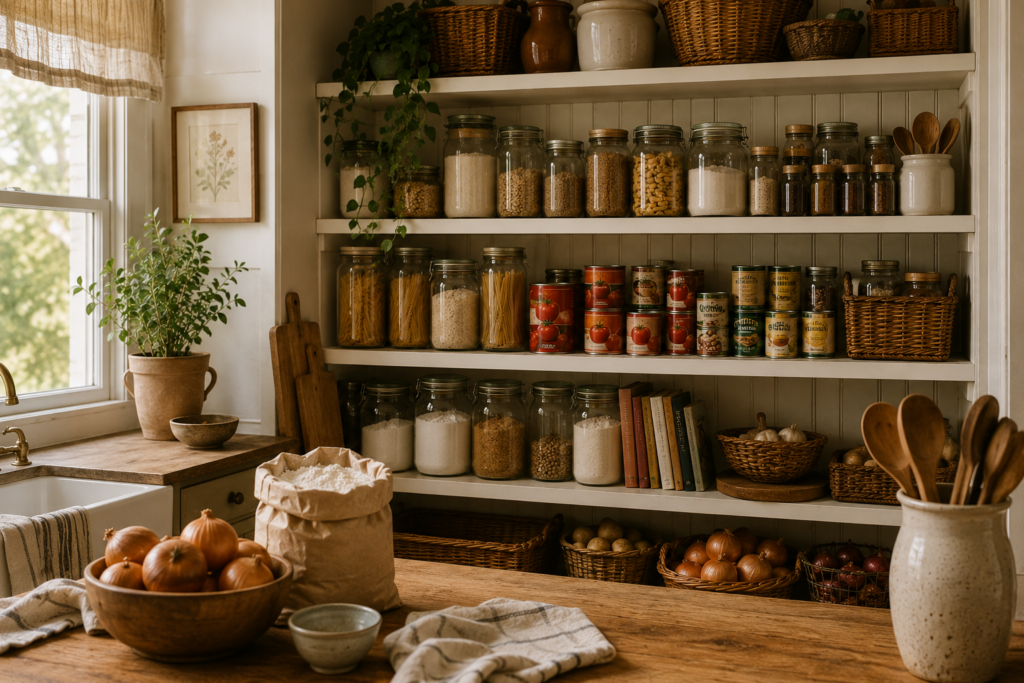
As the weather begins to cool and the days get a little shorter, the way we cook at home naturally begins to change. Soups start simmering on the stove again, chili makes its way back onto dinner rotation, and suddenly baking a loaf of pumpkin bread on a cool afternoon sounds pretty good.
Fall is also a good time to take a look at your pantry and make sure you have the basics on hand for the season ahead.
But preparing your pantry for fall doesn’t mean going to the grocery store and spending hundreds of dollars stocking every shelf.
A well-stocked pantry isn’t about having a picture-perfect pantry or owning every ingredient you might possibly need. It’s about making everyday life easier.
When you keep a few dependable staples on hand, you can pull together dinner on a busy evening, adjust when plans unexpectedly change, bake something without making another trip to the store, or simply look through what you have and figure out something to feed your family.
The goal isn’t a perfect pantry.
It’s a pantry that works for you.
How to Build a Pantry System That Saves Money on Groceries: A Beginner’s Guide
______________________________
Why a Well-Stocked Pantry Makes Life Easier
One of the biggest benefits of keeping a basic pantry stocked is simply knowing that you can almost always make something.
Life doesn’t always go according to plan. You might get home later than expected, the weather might keep you home, somebody’s schedule might change, or you might just be too tired to make another trip to the grocery store.
When you have some basic ingredients in the pantry and a few things in the freezer, dinner becomes much easier.
A well-stocked pantry can help you make fewer last-minute grocery trips, put together simple meals on busy nights, take advantage of sales, stretch what you already have into another meal, and avoid relying quite so often on takeout or convenience food.
For me, that’s the real value of keeping a pantry stocked. It’s not about having a huge supply of food.
It’s about making everyday homemaking a little easier.
________________________
Stock the Foods Your Family Actually Eats
Before you make a giant pantry shopping list, think about what your family actually eats.
There are plenty of lists online telling you that every pantry needs this grain or that particular kind of bean. But if your family doesn’t eat those foods, they’re not doing you much good sitting on a shelf.
Instead, think about five or ten meals you make regularly.
What ingredients appear over and over again?
Those are the things worth keeping around.
My own pantry is fairly well stocked because I’ve built it over time, but that certainly doesn’t mean you need everything I keep. I’m sharing these staples as ideas because they’re foods I genuinely use in my own cooking.
Start with what makes sense for your household and build from there.
The Only Grocery List You Need For a Well-Stocked Home
Canned Tomatoes: One of My Most-Used Pantry Staples
I always keep several kinds of canned tomatoes on hand:
- Diced tomatoes
- Crushed tomatoes
- Tomato sauce
- Tomato paste
They’re the base for so many things I cook-chili, soups, spaghetti sauce, casseroles, and plenty of other simple meals.
If you’re just beginning to build a useful pantry, canned tomatoes are one of the first things I’d consider adding. They’re inexpensive, store well and can help turn a few other ingredients into dinner.
Keep the Beans You’ll Actually Use
You don’t need every variety of bean available.
I keep the ones we actually eat:
- Black beans
- Pinto beans
- Baked beans
- Cannellini or other white beans for soup
- Green beans
I don’t particularly care for kidney beans, so I don’t devote pantry space to them just because they’re traditionally considered a pantry staple.
Your pantry should reflect the way your household eats.
That’s much more useful than trying to follow someone else’s perfect pantry checklist.
Broth Without Filling the Pantry With Cartons
Once soup season arrives, broth gets used quite a bit in my kitchen.
But I don’t keep a large supply of cartons because they take up a lot of pantry space.
Instead, I usually keep bouillon or Better Than Bouillon on hand. It takes up very little room and lets me make whatever amount of broth I need.
I also keep a few cans of cream soup around for convenience, although I don’t use them very often. Most of the time, I prefer making my own simple cream sauces from scratch when making casseroles.
The point isn’t that you need to do it exactly the way I do. Figure out which version of a staple works best for the way you cook and the storage space you have.
Pasta, rice, Potatoes and Onions
These are some of the workhorses of my pantry.
I always keep pasta around, and I don’t worry too much about having specific varieties. Spaghetti, macaroni, penne, orzo-whatever we’re currently using gets rotated through the pantry.
Pasta is inexpensive, stores easily and can become so many different meals.
I also keep:
- Rice
- Egg noodles
- Potatoes
- Onions
And yes, I consider potatoes and onions part of my pantry.
They’re in expensive, filling, versatile, and especially useful when you’re feeding several people.
Combine these basics with a protein and a few other ingredients, and you can make soups, casseroles, pasta dishes, skillet meals and plenty of hearty side dishes.
Homestyle Salisbury Steak with Creamy Onion Gravy
Keep a Few Easy Proteins in the Pantry
I like having a few shelf-stable proteins available for days when I need something quick.
Tuna can become tuna melts, sandwiches, or an easy tuna casserole.
Canned salmon gives me what I need to make salmon patties.
Canned chicken is convenient for quick recipes or something like buffalo chicken dip.
And I even keep some canned chili around. Add hot dogs and buns and you’ve got chili dogs on a night when dinner just needs to be simple.
Not every dinner needs to be impressive.
Sometimes everyone just needs to be fed.
Baking Staples I Always Keep on Hand
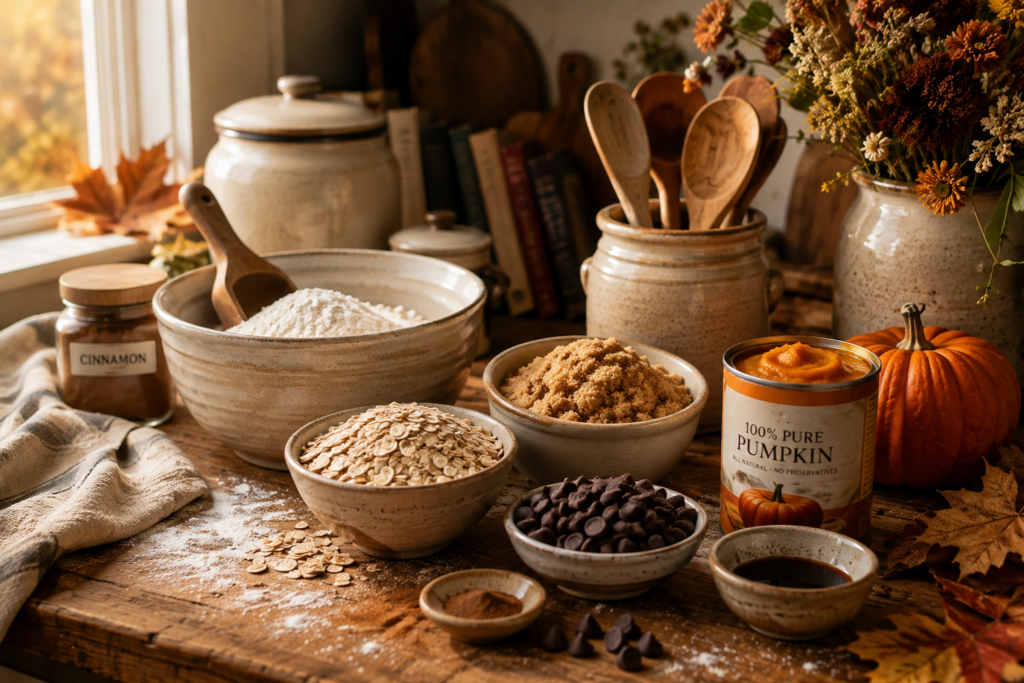
Fall is when I naturally begin baking more, so I like knowing that my basic baking ingredients are already in the house.
I keep several different kinds of flours because I use them for different things.
Self-rising flour is what I use for homemade biscuits.
Bread flour is what I keep for sourdough and other bread baking.
And all-purpose flour is my everyday flour for cookies, muffins, quick breads and most other baking.
Along with flour, I generally keep:
- Granulated sugar
- Brown sugar
- Confectioner’s sugar
- Baking powder
- Baking soda
- Yeast
- Old-fashioned oats
- Chocolate chips
- Vanilla extract
- Cinnamon and other baking spices
You certainly don’t need three kinds of flour if you won’t use them.
If your family loves homemade biscuits, keep what you need to make biscuits. If you bake bread regularly, bread flour makes sense. If you rarely bake, you may only need all-purpose flour.
Keep what supports the way you actually cook.
A Few Fall Baking Favorites
There are a few additional ingredients I like having around once fall baking begins.
Canned pumpkin is an obvious one in our house. I also keep evaporated milk and sweetened condensed milk for baking.
I usually have different kinds of nuts as well, but I store those in the freezer to help them stay fresher longer.
Dried cranberries and dried blueberries are handy for cookies, homemade granolas and other fall baking.
Again don’t buy these things simply because it’s fall. Buy the ingredients you’re actually looking forward to using.
Pumpkin Chocolate Chip Quick Bread
Honey-Roasted Peanut Butter Granola
Oils, Vinegars and the Little Things That Make Food Taste Good
Some of the most useful pantry ingredients aren’t particularly exciting. They’re simply the things that allow you to turn basic ingredients into an actual meal.
I generally keep:
- Refined coconut oil
- Avocado oil
- Olive oil
- White vinegar
- Apple cider vinegar
- Rice vinegar
- Cornstarch
- Breadcrumbs
- Panko breadcrumbs
- Worcestershire sauce
- Soy sauce
Along with those, I keep the herbs and spices I use regularly.
You don’t need every oil, vinegar or seasoning available. Start with the ones that appear repeatedly in the recipes you already make.
Keep a Few Convenience Foods Too
I also keep a few simple convenience foods in my pantry.
Things like canned vegetables and fruit, applesauce, rice mixes, and a few boxes of mac and cheese all have a place in my pantry.
There’s nothing wrong with having some shortcuts available.
A rice mix can quickly become a side dish for chicken from the freezer. Canned vegetables can round out a meal when you don’t have fresh vegetables in the house. And sometimes a box of mac and cheese is exactly what you need on a particularly busy night.
You don’t need a pantry full of convenience foods. Just keep a few things your family likes that can help you get a meal on the table when time and energy are short.
A well-stocked pantry isn’t about cooking everything from scratch.
It’s about making your kitchen work for your real life.
Don’t Forget About Your Freezer
Even though we’re talking about stocking the pantry, I really consider my freezer an extension of it.
A pantry full of dry and canned goods becomes much more useful when you can combine those foods with a few basic proteins, vegetables and dairy products.
I try to keep things like:
- Butter
- Ground Beef
- Chicken
- Blocks of cheese
- Frozen vegetables
I generally buy blocks of cheese and shred them myself, and I freeze quite a few foods so they’re available when I need them.
This is where having a stocked kitchen really starts paying off.
Ground beef in the freezer plus pasta and tomatoes in the pantry?
You have dinner.
Chicken, bouillon, egg noodles and frozen vegetables?
You can make soup.
Chicken, rice, frozen vegetables and soy sauce?
There’s another simple meal.
Potatoes, onions and some meat from the freezer?
There’s dinner again.
When you keep versatile ingredients around that work together, you don’t necessarily need to have every meal planned days in advance.
A Simple Weekly Meal Planning System for Everyday Homemaking
How to Stock Your Pantry Without Blowing the Grocery Budget
Please don’t look at everything I’ve listed here and think you need to buy it all this weekend.
You don’t.
My pantry has been built over time, and yours can be too.
Start by shopping your own pantry. See what you already have, checking expiration dates, move older items toward the front and notice which basics are getting low.
Then watch the sales.
If your family regularly eats pasta, and it’s o n sale, buy a few extra boxs.
If canned tomatoes are a good price, buy extra.
If flour is on sale and you know you’ll be baking, that’s a good time to replace what you’re running low on.
You don’t need twelve of everything.
Buying one or two extras of foods you already use can slowly create a very useful pantry without taking a huge bitr out of one week’s grocery budget.
_________________________
Want More Simple Homemaking Ideas?
If you enjoy practical homemaking advice that helps make everyday life a little easier, I’d love to have you join me for The Home Journal.
Each week I share simple homemaking ideas, encouragement, recipes and practical ways to create a home that works well for real life.
____________________________
Don’t Stock an Aspirational Pantry
This might be one of the most important things to remember:
Don’t stock an aspirational pantry. Stock your real pantry.
If nobody in your house eats lentils. don’t buy six bags of lentils because a pantry checklist told you they’re a good staple.
If you never bake bread, you probably don’t need several bags of flour.
If your family eats pasta twice a week, on the other hand, keeping boxes of pasta makes perfect sense.
A useful pantry isn’t the pantry with the most food.
It’s the pantry containing foods that actually become meals.
Try the One-Shelf Method
If all of this still sounds like a lot, here’s where I’d start.
Choose one shelf.
That’s it.
Maybe that shelf becomes your baking shelf. Maybe it’s your soup shelf. Maybe you decide to stock pasta, tomatoes, and other easy dinner ingredients there.
Take a few minutes to straighten that one shelf, check what you already have and write down five staples you’re missing or running low on.
Then, the next time you grocery shop, buy one or two of them.
You don’t even have to buy all five,’
Do the same thing the following week.
Over time, one useful shelf becomes two. Your baking supplies get stocked. You add a few things to the freezer. And before long, you have the ingredients to make many of the meals your family already loves.
A Well-Stocked Pantry Is Really About Making Life Easier
You don’ t need a giant pantry, matching containers or hundreds of dollars worth of groceries to have a well-stocked kitchen.
You need a collection of simple ingredients that work together.
That’s what makes a pantry valuable.
When it’s 5:00, plans have changed, everyone is hungry and you really don’t want to make another trip to the grocery store, you can look through your pantry and freezer and think:
I can make something with this.
And really, that’s the whole point.
Your Simple Pantry Challenge
Sometime this week:
1.Choose one pantry shelf.
2. Straighten up what you already have.
3. Move older foods toward the front.
4. Write down five staples your household actually uses.
5. Add one or two of them to your grocery list.
Then stop.
You don’t have to tackle the rest of the pantry today.
Small habits, repeated over time, are what create a kitchen that serves you well-and makes getting dinner on the table just a little bit easier.
from my hearth to yours,
Becky
Leave a Reply